Production time has a price, and the roof plan has to respect it
An automotive plant tells you what a stopped line costs before the contract is signed, and that number changes everything about how the roof gets done. Automotive manufacturing roofing in Fort Myers means working over assembly, stamping, machining, and Tier 1 and Tier 2 supplier operations where a roofing-driven interruption is measured in dollars per hour. We plan, mobilize, and sequence with that figure in front of us, so the work moves the production schedule forward instead of fighting it.
The region's industrial base has scaled up to support this kind of tenant. Large single-envelope buildings have filled in along the I-75 freight spine, including an 818,000-square-foot building in the Tri-County area and the newer high-clear campuses such as the Gulfcoast Industrial Campus, with manufacturing and supplier space also concentrated along Alico Road, Metro Parkway, and the airport industrial corridor. Roofs at that scale are a logistics exercise as much as a roofing one.
Big decks demand phased planning
Assembly and supplier plants carry some of the largest continuous roof decks in commercial construction. A single envelope can run from a few hundred thousand to a few million square feet, and you cannot reroof that the way you reroof a shopping center. We section the roof into manageable zones, sequence tear-off and material delivery to stay inside crane reach and laydown limits, and keep production running in the zones adjacent to active work. The plan exists so that work in one phase never threatens the line two bays over.
Paint shop zones change the rules
The paint shop is the part of the roof that rewrites your safety plan. Paint operations put solvent vapor in the air and bring fire-suppression requirements that govern hot-work permits, adhesive selection, and any torch use. Over and around paint-adjacent zones we develop a hot-work plan with your environmental health and safety team before a tool comes out, and we specify cold-applied adhesive or mechanical attachment instead of torch or solvent-based systems where exclusions apply. None of this is a surprise on a paint shop roof; it is standard scope, and we plan for it from the start.
Press and machining vibration fatigue seams
Stamping, casting, and powertrain lines move the building. Large presses and heavy machining transmit vibration up through the structure to the roof level at frequencies that ordinary single-ply seam design was never asked to tolerate. Over time that energy can fatigue a poorly welded or adhesive-bonded seam. In press-adjacent and machining zones we account for vibration exposure in both the membrane specification and the welding procedure, so the seams hold up to the constant low-frequency working that those areas generate.
Ventilation, weld smoke, and rooftop heat
Manufacturing floors run hot and need to breathe. Weld smoke, process heat, and forklift exhaust get pulled out through ridge ventilators, gravity vents, and powered exhaust fans, and every one of those is a roof penetration that has to be flashed and maintained. The density of mechanical units on a plant roof, combined with the Southwest Florida sun beating on a dark deck all summer, also makes a strong case for a reflective white membrane: a cool roof drops the rooftop surface temperature, eases the load on the floor's ventilation and any conditioned office areas, and slows the heat aging of the membrane itself. We weigh that against your existing assembly and energy goals when we set the spec, rather than defaulting to whatever was there before.
How we keep an active plant dry and documented
- Daily dry-in before every shift change. We confirm each open section is watertight before the next crew clocks in, with direct contact to your maintenance foreman throughout.
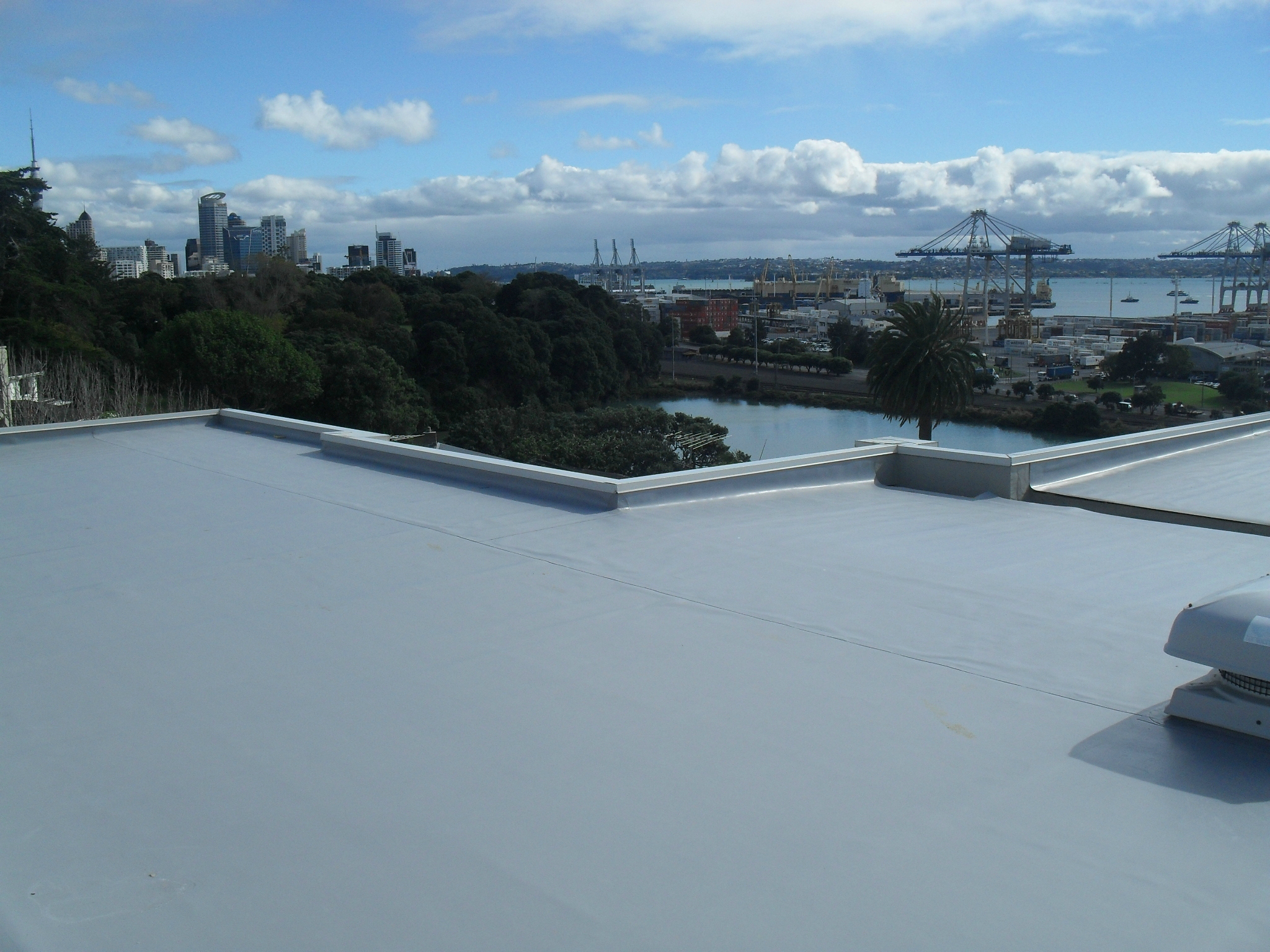
- Membrane matched to the span. 60-mil or 80-mil TPO mechanically attached is our common large-span spec, with fully adhered systems in paint zones where fastener patterns conflict with hot-work limits, and tapered insulation where drainage has gone flat.
- Storm-rated for this coast. Hurricane Ian reset expectations on attachment and edge metal here. We document the system to current wind requirements so a multi-million-dollar deck is not the weak point in the next event.
Tier 1 and Tier 2 supplier facilities get the same treatment as an OEM plant, often with even less tolerance for downtime because of just-in-time delivery. We document the production schedule, sequence around it, and hold daily communication with your facilities contact. Closeout documentation is delivered in the format your engineering department requires, including safety qualification records, warranty registration, a roof-zone penetration inventory, daily reports, and a photographed condition survey.
Automotive Manufacturing Roofing Questions
How do you minimize disruption on an active assembly plant?
Production continuity governs every scope decision. Before mobilization we document shift schedules with your facility engineering team, map which roof zones sit over active lines, and build a zone-by-zone phasing plan that keeps work clear of production. Daily dry-in is confirmed before each shift change, with direct contact to your maintenance foreman.
How do you handle hot-work restrictions over the paint shop?
Hot work over or near paint operations needs pre-approval from your EHS team before any torch, grinder, or welding use. We build the hot-work permit plan during pre-construction and specify cold adhesive or mechanical attachment where torch exclusions apply. These are standard planning items for automotive roofs, not surprises.
What membrane do you specify for large-span plant roofs?
60-mil or 80-mil TPO mechanically attached is the common spec for large-span automotive roofs here. Fully adhered systems go in paint zones where fastener patterns conflict with hot-work rules, tapered insulation goes where drainage is deficient, and we confirm existing deck capacity before setting insulation thickness.
Do you work on Tier 1 and Tier 2 supplier plants?
Yes. Supplier facilities bring the same coordination needs as OEM plants, often with tighter just-in-time pressure and zero tolerance for interruption. We document the production schedule, sequence around it, and keep daily communication with your facilities contact.
What documentation do automotive manufacturers require?
Closeout typically includes contractor safety qualification records, a site-specific safety plan, OSHA log summary, manufacturer warranty registration, a roof-zone diagram with penetration inventory, daily work reports, permit records, and a photographed condition survey, all formatted to your plant's corporate facility-management standards.