
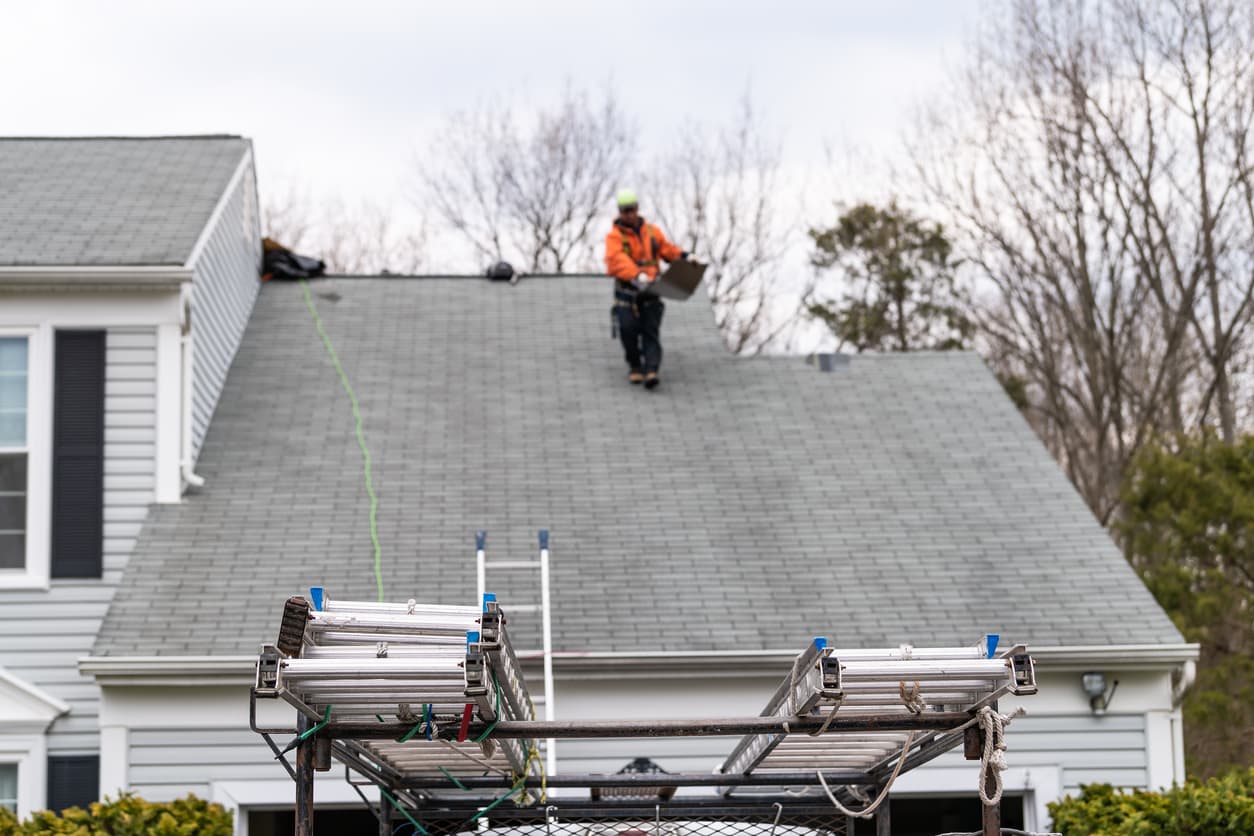
Not every wind claim in Fort Myers starts with a named storm. Southwest Florida's summer pattern brings fast-building afternoon thunderstorms with real gusts, and those cells can lift edge metal, work a seam loose, or drive rain sideways under a poorly sealed penetration well before hurricane season gets any attention. The damage is often less dramatic than a hurricane loss but no less real, and it gets missed just as easily from the ground.
We're your roofing contractor, not a public adjuster. We inspect the roof, document the wind or storm damage we find, and produce a written assessment — we don't file the claim, negotiate with the carrier, or promise a specific payout.
How Wind Damage Shows Up on a Low-Slope Roof
Membrane displacement usually starts at the field and at seams before it becomes visible at the edge. Edge metal and coping are the first line of defense against Gulf-driven wind, and on Lee County commercial buildings that have carried a few storm seasons already, a lifted section can be new damage sitting on top of older wear. We document the difference: fresh displacement with a directional pattern consistent with recent wind, versus long-term corrosion that predates the event.
Rooftop equipment — condensing units, exhaust fans, curb-mounted skylights — can shift or take on wind-driven rain at the flashing even when the membrane itself holds. We check curb flashing and equipment anchoring as part of the same inspection, since interior leaks often trace back to a curb rather than the field membrane.
Drainage is part of the wind story too. A storm that drops heavy rain on top of gusty wind can overwhelm a roof's drains and scuppers faster than they were sized to handle, and standing water that sits on a low-slope membrane after the wind dies down can hide developing damage under a reflective surface that looks fine from a distance. We check drain and scupper condition alongside membrane and edge metal on every storm-related inspection.
Hail, Briefly
Hail is uncommon in this part of Southwest Florida. When a strong summer cell does produce it, we document impact marks on the membrane the same way we document any storm-related surface damage — photographs, impact locations by roof section, and a note on membrane condition at each point. It's a small part of most Fort Myers wind claims, not the main story.
Building the Storm Damage File
Properties along the Alico Road logistics corridor and the Gateway/Colonial Boulevard commercial belt often run large single-membrane roofs where wind damage can be widespread but low-profile — easy to underestimate without a section-by-section walk. Downtown River District buildings and older Cape Coral commercial stock carry more roof-section variety and prior patch history, which we sort out before attributing new damage to the current storm. Either way, the file includes dated photos, measured affected area, and moisture readings anywhere ponding or an interior stain suggests water got past the surface.
The goal of that file is a complete, accurate picture of what the storm did to the roof — nothing legitimate left off, nothing assumed that the roof doesn't show.
Getting Started
If a storm has already passed and there's an active leak, we prioritize emergency tarp and dry-in to stop interior damage first. From there, a full inspection supports the claim file and the repair scope together. Because wind damage often shows up gradually rather than as a single obvious tear, a roof that seemed fine in the days right after a storm is still worth a documented look before the file gets closed out. Commercial Roofing of Fort Myers is reachable at 239-441-3476 for a wind or storm damage roof review.
Fort Myers Wind & Storm Claim Roofing Questions
What wind damage typically shows up on a commercial roof here?
Membrane displacement at seams and laps, lifted edge metal or coping, and flashing pulled loose at curbs and penetrations are the most common patterns, from both tropical systems and strong summer thunderstorms.
Does a summer thunderstorm count as a covered wind event?
It can, depending on wind speed and the resulting damage against the policy's definition of a covered event. We document the physical damage; whether it clears the policy threshold is a question for the owner's carrier.
Is hail a real concern in Fort Myers?
It's uncommon compared to wind and rain. When it happens, it's usually tied to a strong summer storm cell, and we document any impact damage the same way we document other storm-related membrane damage.
How do you separate storm damage from an installation issue?
By failure pattern. Wind damage tends to concentrate at edges, corners, and high-uplift zones in a direction consistent with the storm. Installation problems tend to be isolated and unrelated to a specific weather event, and we note that distinction honestly.
What do you hand the owner after the inspection?
Dated photos organized by roof section, measurements of the affected area, notes on membrane and edge condition, and moisture readings where relevant — a file built to support the owner's own conversation with their carrier.